
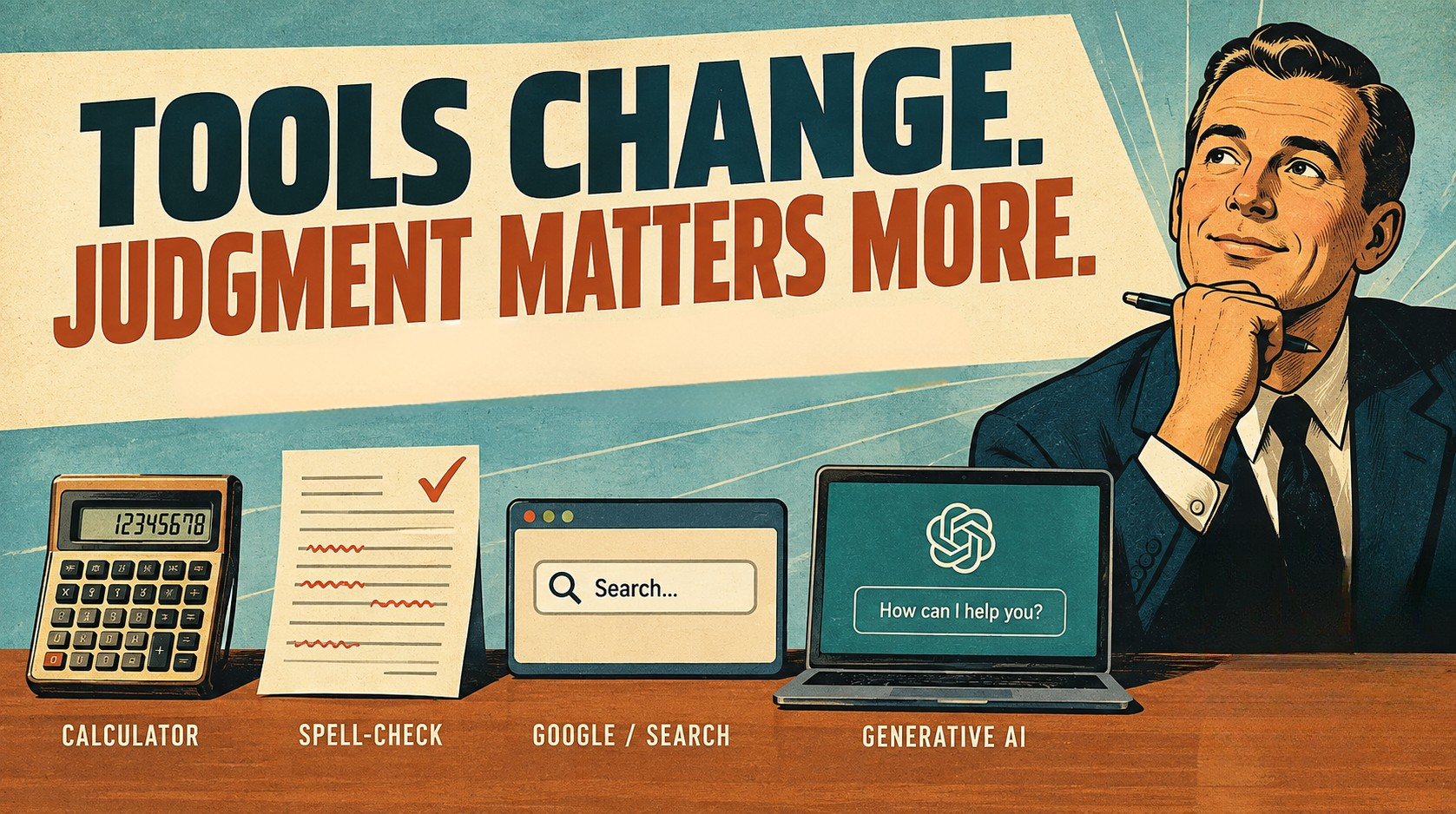
Tools Change. Judgment Matters More.
As producing more becomes easier, deciding what matters becomes harder.
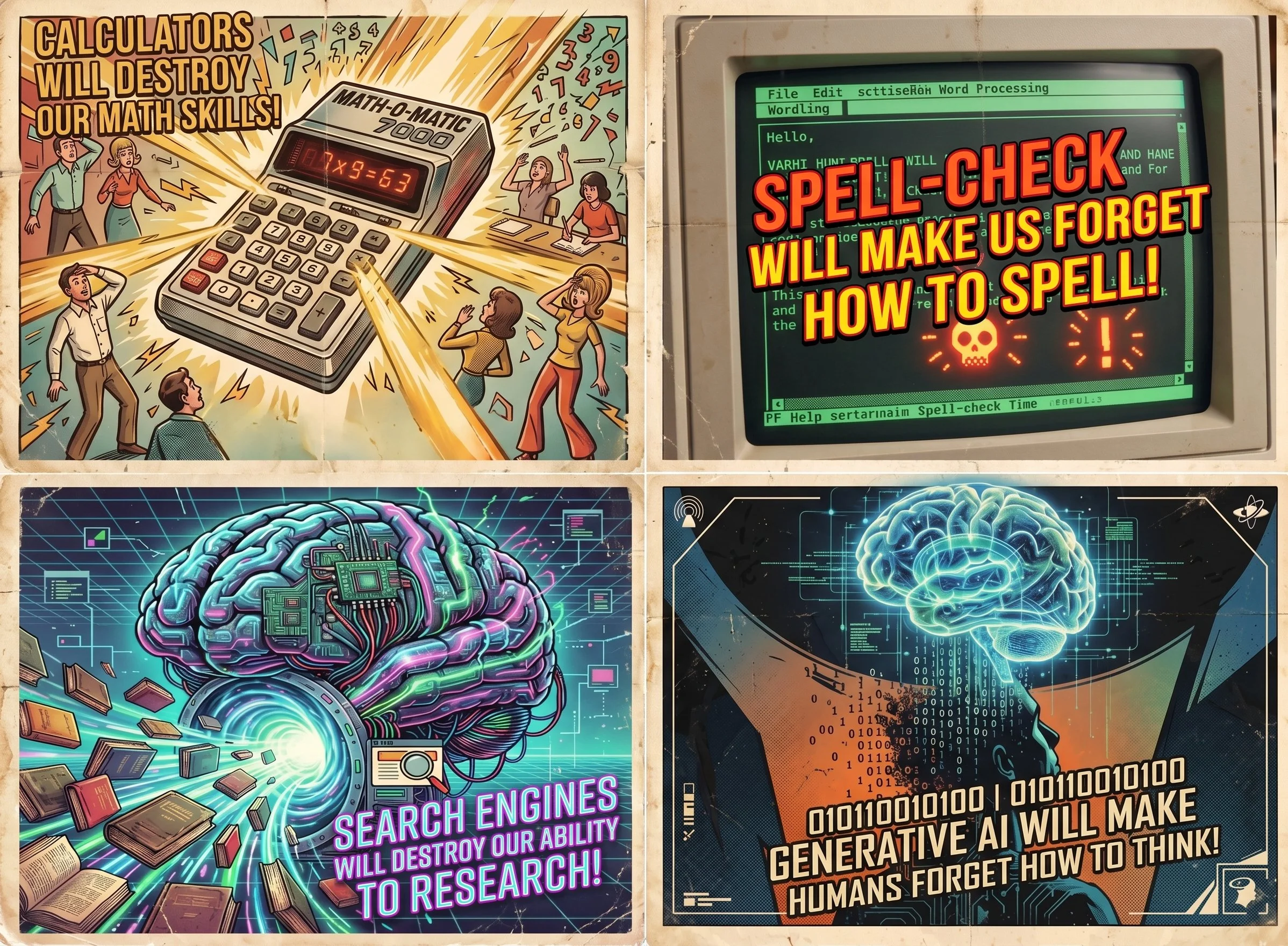
Every generation gets a new tool, and a new warning that it will ruin us.
Calculators would weaken our math skills.
Spell-check would make us forget how to spell.
Google would eliminate the need to know how to research.
Now generative AI will make us forget how to think.
Some of those predictions haven't aged particularly well. →
That doesn't mean generative AI is simply the next calculator. Its capabilities are considerably greater, as are the questions and risks surrounding its use. Those deserve serious attention.
But in our everyday work, AI raises a familiar question: Does the tool replace our thinking, or give us greater capacity to think well?
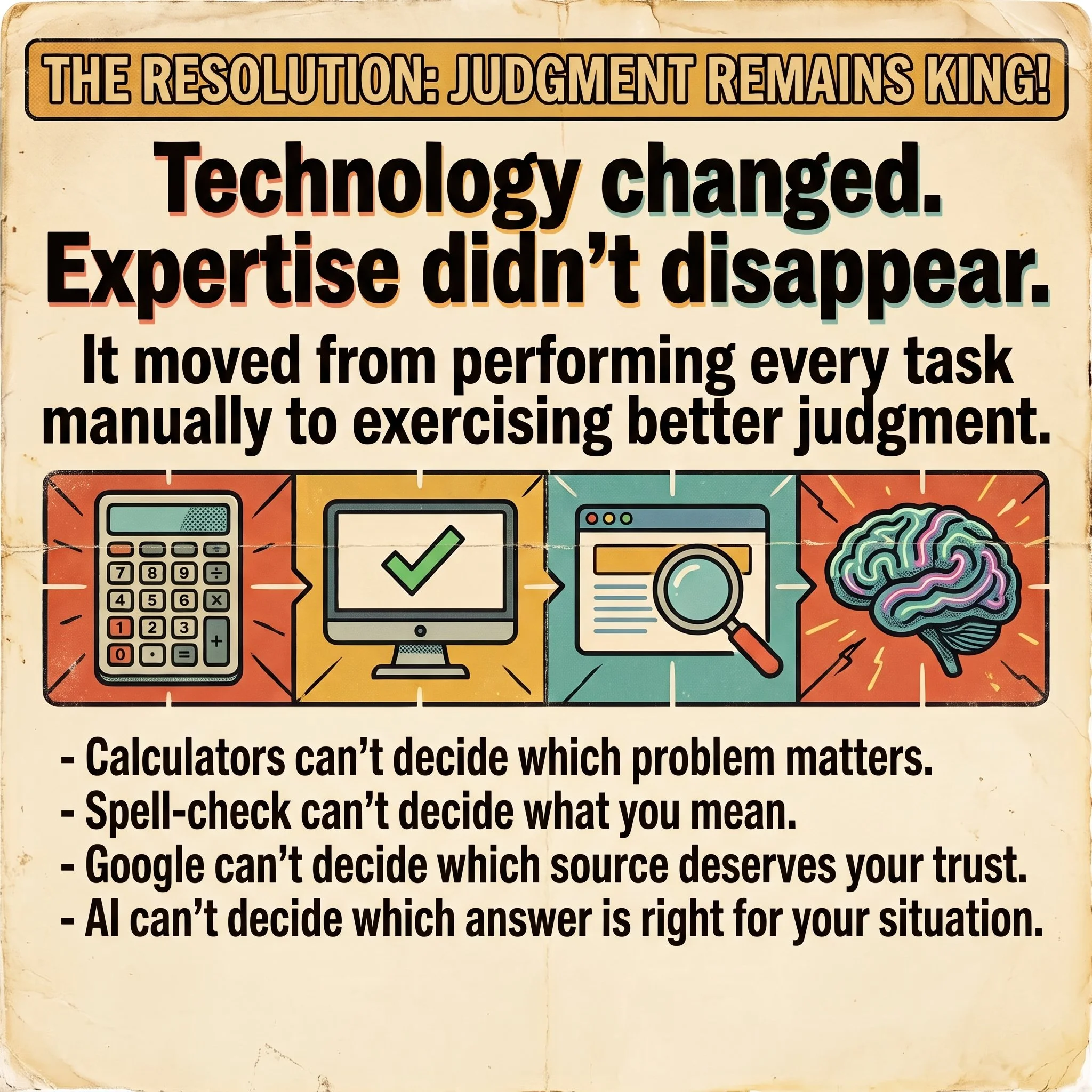
The tools changed. So did the skills that mattered most.
Calculators didn't eliminate the need to understand mathematics. They made routine computation faster.
Spell-check didn't eliminate the need to write well. It made catching certain mistakes easier.
Google didn't eliminate the need to know things. It dramatically changed how quickly we could find information and made evaluating what we found more important.
Each technology took something that required time and effort and made it easier.
Expertise didn't disappear. The valuable part of the expertise shifted.
Generative AI is accelerating that shift.
AI can analyze information, generate ideas, create content, and recommend courses of action. Increasingly, it can perform tasks that once required considerable human time and skill.
But producing an answer and knowing what to do with the answer aren't the same thing.
People still provide context. We decide which questions are worth asking. We interpret results. We weigh consequences. And ultimately, we're accountable for the decisions we make.
Sometimes expertise means knowing how to use the tool.
Sometimes it means knowing when to ignore it.
Marketing has a new abundance problem.
This is particularly consequential for expertise-driven organizations.
For years, one of the constraints on marketing was production capacity. Creating an article, presentation, campaign, or research report required significant time and resources.
Generative AI changes that equation.
Now it's possible to research, draft, edit, repurpose, and distribute content at a speed that would have been hard to imagine not long ago.
That's an extraordinary opportunity.
It's also a problem.
Because the fact that we can produce more doesn't mean that we should.
Professional services firms don't need ten mediocre articles simply because AI lets them produce ten in the time it once took to create two good ones. They don't need more content that sounds like everyone else's content. And they don't strengthen their market position simply by filling more channels more frequently.
As content production becomes easier, deciding what is worth saying becomes more important.
What does the firm genuinely know that its clients would find useful?
Where does it have a distinctive point of view?
Which ideas demonstrate how its experts think rather than merely what they know?
What should it choose not to publish?
Those aren't primarily production questions. They're questions of strategy and judgment.
The opportunity isn't to think less.
That's why I'm less interested in whether AI will make marketing easier than in what marketers and their organizations will do with the capacity it creates.
Used thoughtfully, AI can give us more time to investigate, question, compare, experiment, and refine. It can help us get past the blank page faster and explore possibilities we might otherwise miss.
But greater capacity doesn't automatically produce better marketing.
That still depends on knowing the audience, understanding the organization, recognizing what makes its expertise valuable, and deciding what deserves attention.
The tools will continue to evolve. So will the skills required to use them well.
Producing content has never been easier. Knowing what's worth saying has never been harder.
Let’s start a conversation
Whether you’re launching a new service, repositioning your firm, strengthening thought leadership, or exploring fractional marketing leadership, I’d welcome the opportunity to learn more about your goals.
Scott Sutton advises expertise-led organizations on marketing strategy, thought leadership, and market visibility.
