
How Buyers Find and Evaluate Expertise Is Changing. Again.
From referrals to search to AI, what evolving buyer behavior means for professional services firms.
Marketing in expertise-led firms has always been about making expertise visible, understandable, and trustworthy. What keeps changing is how prospective clients discover and evaluate that expertise. Over the past thirty years, the internet has changed that process considerably. AI is changing it again.
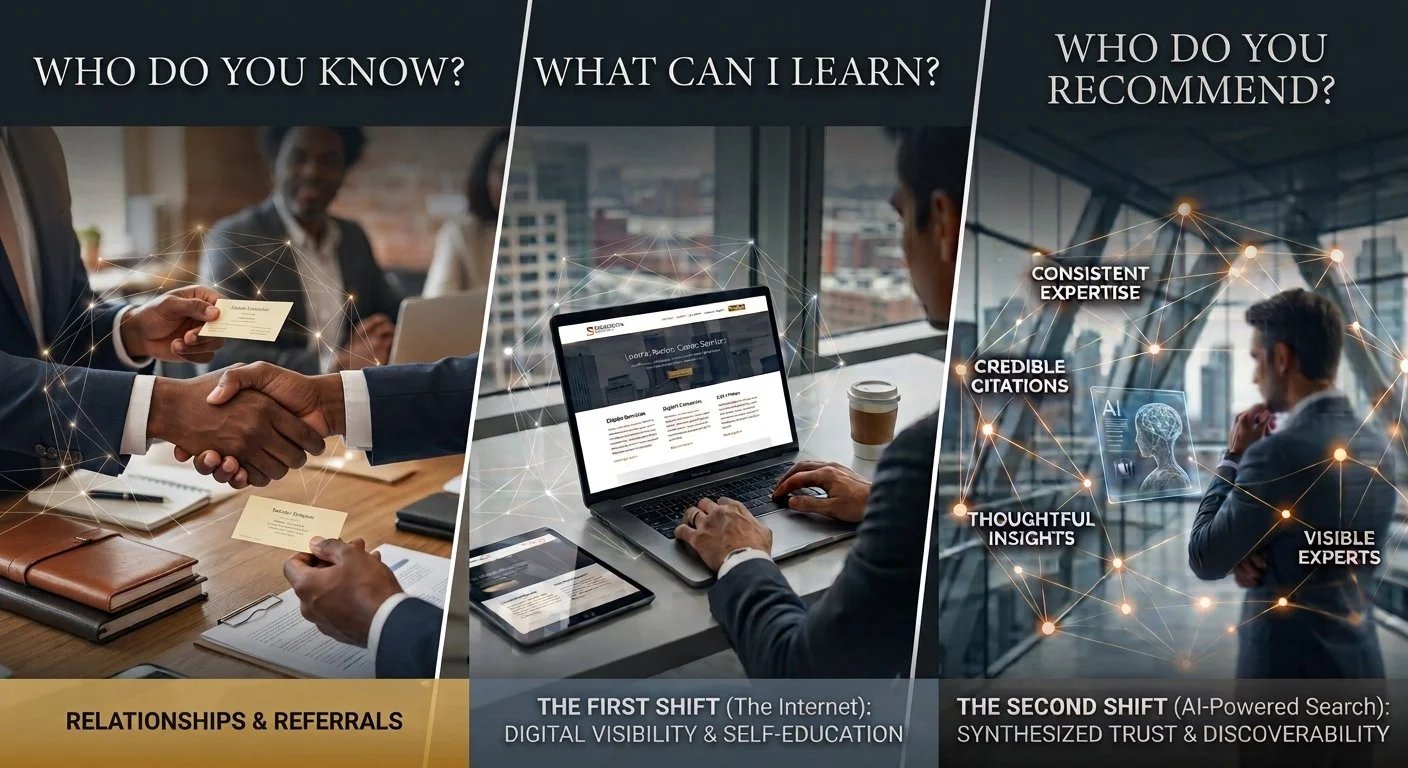
Each shift affects how buyers research firms and requires professional services firms to rethink how they communicate their expertise. Relationships and referrals remain important, even as buyers use search and AI to find and evaluate firms.
The Relationship Era: Who Do You Know?
For decades, expertise-led firms relied primarily on relationships, referrals, and reputation. That approach made sense. Clients were making high-stakes decisions, often involving legal matters, strategic advice, or organizational change. Trust mattered more than promotion. If new business consistently came through existing clients and professional networks, there was little reason to invest heavily in marketing.
Professional cultures also played a role. Many firms operated as partnerships where technical expertise was valued far more than marketing capability. Some viewed marketing as unnecessary, or even inconsistent with the professionalism they wanted to project. In certain industries, legitimate regulatory and ethical constraints also limited communications.
Before the internet, experts largely controlled access to information. Prospective clients depended on conversations, presentations, brochures, and personal introductions to learn about a firm’s capabilities.
The buyer's question was simple:
“Who do you know?”
The Internet Era: What Can I Learn?
The internet fundamentally changed that relationship. Suddenly, buyers could educate themselves before ever speaking with a consultant, attorney, or advisor. Websites, articles, research reports, webinars, and search engines allowed prospective clients to investigate firms independently. Marketing now had a larger job: helping prospective clients understand a firm’s expertise long before the first conversation.
The internet also expanded competition. Firms that once competed primarily within their own city suddenly found themselves competing nationally and internationally. Visibility became a competitive necessity.
I experienced this transition firsthand when I took a marketing leadership role at a small global HR consultancy in the early 2000s. The firm had strong client relationships and a respected niche reputation. It also had a static website that hadn’t been updated in years and a leadership team that wasn’t convinced it needed a better one.
Many senior leaders genuinely questioned whether marketing deserved significant investment. The prevailing belief was that business would continue arriving through referrals and consultant relationships. Even the idea of replacing the website was initially viewed with skepticism. One senior leader told me, not unkindly, “Our clients don’t find us through websites. They find us through word of mouth.”
He wasn’t wrong about how things worked in the past. But buyer behavior had already started changing. Prospective clients were beginning to research firms before reaching out, checking credentials, reading bios, and looking for evidence of expertise before committing to a conversation.
Looking back, the breakthrough was getting the leadership team to recognize that buyers were researching firms differently and that our marketing needed to reflect that.
The buyer's question had become:
“What can I learn?”
The AI Era: Who Do You Recommend?”
AI is introducing another way for buyers to research providers, understand complex issues, compare alternatives, and identify firms with relevant expertise.
AI-powered search tools go beyond presenting links. They draw on information from multiple sources to generate answers and suggest providers. That gives firms another reason to make their expertise clear and well supported online. Being included in an AI response, however, is not proof of expertise or a guarantee of being chosen.
Visibility alone does not establish credibility. Firms need to give buyers clear evidence of their expertise through useful insights, specific service descriptions, and opportunities to hear from their experts. Earning citations and participating in industry conversations also help firms build a reputation over time.
The buyer's question is becoming:
“Who do you recommend?”
Seeing the Shift Again
Recently, I spoke with a partner at a well-established Boston law firm. The firm had decades of strong client relationships and a hard-earned reputation in its practice areas.
For years, his firm had been the clear favorite for the work it does, chosen on the strength of its expertise. Now, newer competitors, some from outside the Northeast, were reaching the same prospective clients and, in his words, “out-marketing” his firm. I’ve seen this pattern before: competitors like these invest steadily in thought leadership, raise their experts’ profiles, and maintain a clear digital presence, while some established firms continue to rely heavily on their reputation.
He wasn’t questioning the quality of his firm’s work. He was concerned that competitors were better at getting buyers’ attention and demonstrating their expertise.
I have heard similar concerns in recent months across a variety of expertise-led firms. As AI gives buyers more ways to research providers, those concerns are worth taking seriously.
The Fundamentals Haven't Changed
AI does not change what expertise-led firms sell. They still sell judgment, experience, and trust. What has changed, once again, is how buyers evaluate expertise and decide whom to trust. Thirty years ago, trust was transferred primarily through personal relationships. The internet expanded that process through websites, thought leadership, and digital visibility. Now AI increasingly helps buyers interpret those signals before they ever contact a firm.
Firms that adapted early to the internet built competitive advantages that took others years to close. We are at a similar moment today.
The opportunity is to make expertise easier for both people and AI systems to discover and understand, and to give buyers sound reasons to trust it. What buyers need to know before hiring a firm remains familiar:
· Do these people understand my problem?
· Do I trust their judgment?
· Do I want them advising my organization?
Let’s start a conversation
Whether you’re launching a new service, repositioning your firm, strengthening thought leadership, or exploring fractional marketing leadership, I’d welcome the opportunity to learn more about your goals.
Scott Sutton advises expertise-led organizations on marketing strategy, thought leadership, and market visibility.
